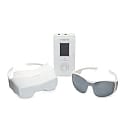
The Kasina by Mindplace: A Review by ChangeThatMind
A Review of the Mindplace Kasina light and sound machine for wellbeing, by Paul at ChangeThatMind.com- 10th August 2017 I was fortunate to be offered the opportunity to undertake a…
Binaural beats, or binaural tones, are auditory processing artifacts, or apparent sounds, caused by specific physical stimuli. This effect was discovered in 1839 by Heinrich Wilhelm Dove and earned greater public awareness in the late 20th century based on claims coming from the alternative medicine community that binaural beats could help induce relaxation, meditation, creativity and other desirable mental states. The effect on the brainwaves depends on the difference in frequencies of each tone: for example, if 300 Hz was played in one ear and 310 in the other, then the binaural beat would have a frequency of 10 Hz.[1][2]
The Binaural beat thus occurs when two tones at slightly different frequencies are presented separately to each ear, using stereo headphones. A beating tone will be perceived, as if the two tones mixed naturally, out of the brain. The frequencies of the tones must be below 1,000 hertz for the beating to be noticeable.[3] The difference between the two frequencies must be small (less than or equal to 30 Hz) for the effect to occur; otherwise, the two tones will be heard separately, and no beat will be perceived.
Binaural beats reportedly influence the brain in more subtle ways through the entrainment of brainwaves[3][8][9] and provide other health benefits such as control over pain
A Review of the Mindplace Kasina light and sound machine for wellbeing, by Paul at ChangeThatMind.com- 10th August 2017 I was fortunate to be offered the opportunity to undertake a…

Guaranteed Altered States of Consciousness. Get immediate control over 100% of your brain's activity using 3D Mind Sync Technology with Mind Sync 3D Stunning new technique in brainwave control Get…
Hemi-Sync: Unleash Your Potential with their Brain Stimulating CDs or MP3s . Hemi-Sync.com® is home to the largest online collection of content to help you relax, focus, meditate, sleep and lead…